AI agents are quickly moving from experimental tools to practical business systems. Unlike traditional chatbots that mainly generate responses, AI agents can understand objectives, plan tasks, access external tools, retrieve information, interact with applications, and execute multi-step workflows. This makes them valuable for automation, but it also creates a new category of security challenges.
An AI agent connected to a CRM, database, cloud platform, email service, or internal knowledge base effectively becomes an operational component of an organization. If an attacker manipulates its instructions or compromises one of its connected tools, the consequences can extend beyond inaccurate AI-generated content.
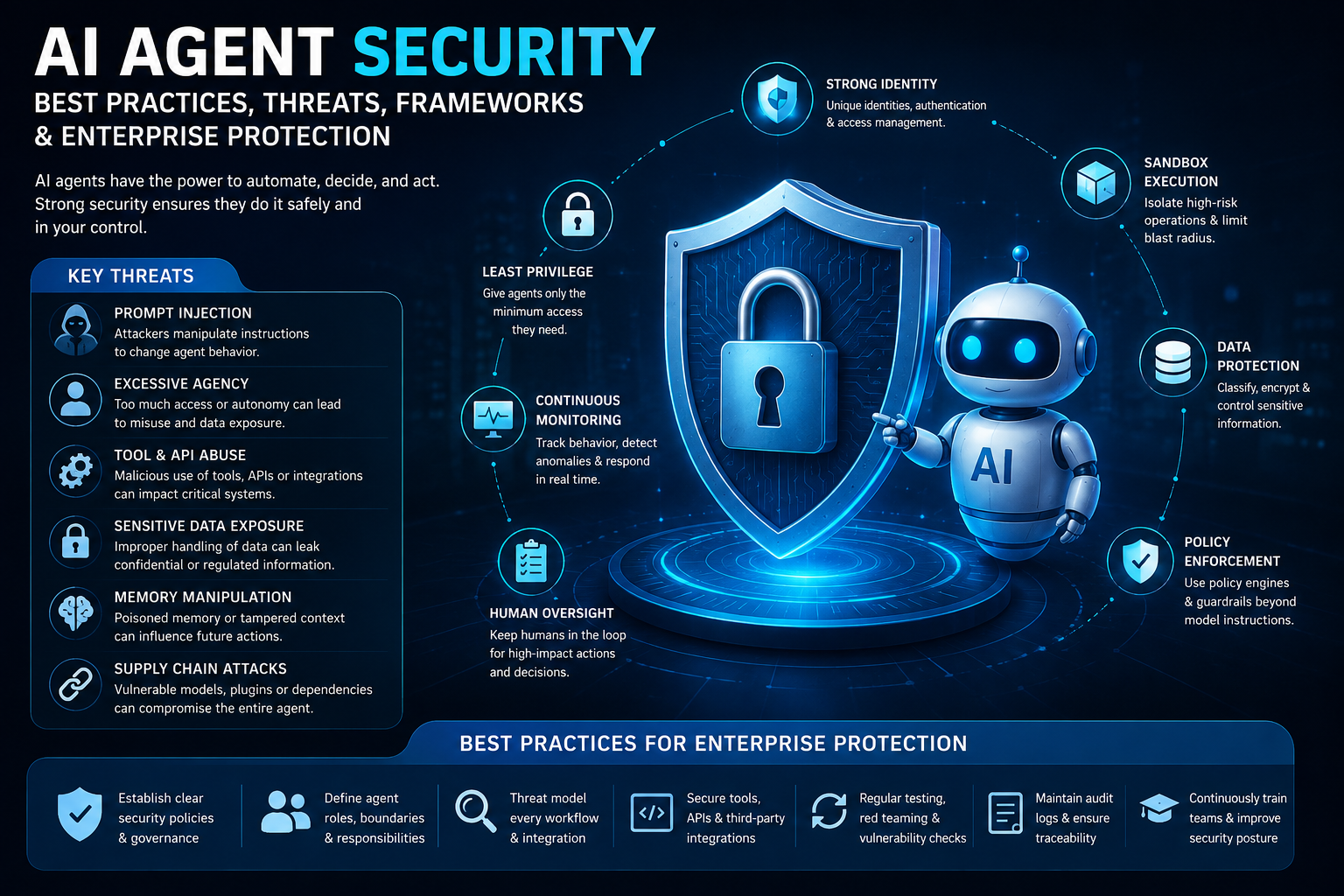
For this reason, securing AI agents requires more than protecting the underlying model. Organizations need a comprehensive approach covering identity, permissions, data, tools, memory, infrastructure, monitoring, governance, and human oversight.
Why AI Agent Security Is Different
Traditional software typically follows predefined logic. AI agents operate differently because they interpret information and dynamically determine which actions to take.
Consider an AI customer-service agent that can access customer records, update tickets, search internal documentation, send emails, and interact with business APIs. Each capability increases the system's attack surface.
The challenge becomes greater when an agent processes information from external sources. A malicious webpage, document, email, or database entry may contain instructions designed to influence the agent's behavior.
Therefore, organizations should treat external information as untrusted data, even when it comes from a legitimate source. The agent must distinguish between information it can read and instructions it is actually authorized to follow.
Major Security Threats to AI Agents
1. Prompt Injection
Prompt injection occurs when an attacker attempts to manipulate an AI system through crafted instructions. In agentic systems, this threat becomes more serious because manipulated instructions can influence real actions.
For example, an agent may be asked to summarize a webpage containing hidden instructions that attempt to make it reveal confidential information or invoke an unauthorized tool.
Organizations should isolate untrusted content from system-level instructions and use deterministic controls to prevent unauthorized actions.
2. Excessive Agency
An agent becomes significantly more dangerous when it has unnecessary permissions.
An AI support agent that only needs to update tickets should not have unrestricted access to customer databases, billing systems, or administrative functions.
The principle of least privilege should apply to agents just as it does to human users and software services. Every permission should have a clear business justification.
3. Tool and API Abuse
Tools transform AI agents from conversational systems into operational systems. Agents may interact with databases, browsers, cloud platforms, payment services, file systems, or enterprise applications.
Each tool creates another potential attack surface.
Organizations should validate tool inputs, restrict available functions, enforce authorization independently of the model, and log every significant tool invocation.
4. Sensitive Data Exposure
AI agents often process sensitive information such as customer records, financial data, proprietary documents, source code, and employee information.
Exposure can result from excessive permissions, insecure retrieval systems, poor logging practices, inappropriate external API calls, or careless handling of prompts and responses.
Data classification, access controls, encryption, data-loss prevention, and retention policies should therefore be integrated into the agent architecture.
5. Memory Poisoning
Persistent memory allows agents to maintain context across interactions, but it introduces another security risk.
An attacker who inserts false or malicious information into an agent's memory may influence future decisions. Memory systems should have access controls, provenance tracking, validation mechanisms, retention rules, and processes for removing suspicious information.
6. Supply-Chain Attacks
AI agents frequently depend on third-party models, libraries, frameworks, plugins, APIs, connectors, and databases. A compromised dependency can become an indirect entry point into the broader system.
Organizations should maintain an inventory of dependencies and conduct security assessments before introducing external components into production agent workflows.
AI Agent Security Frameworks
There is no single framework capable of addressing every agent security problem. Enterprises should combine established cybersecurity principles with AI-specific governance.
NIST AI Risk Management Framework
The NIST AI Risk Management Framework (AI RMF) provides a structured approach for identifying and managing AI risks. Its core functions?Govern, Map, Measure, and Manage?can be applied throughout an AI agent's lifecycle.
Organizations can use these principles to define ownership, identify threats, evaluate controls, and continuously manage risks as agent capabilities evolve.
OWASP Security Guidance
OWASP provides practical guidance for developers and security teams working with AI applications. Its work around prompt injection, excessive agency, sensitive information exposure, insecure integrations, and supply-chain risks is particularly relevant to agentic applications.
The value of OWASP guidance is its practical focus. Teams can translate identified risks into concrete development, testing, and security requirements.
ISO/IEC Standards
Organizations with mature governance programs can also consider standards such as ISO/IEC 42001, which provides requirements for establishing an Artificial Intelligence Management System.
These standards can help organizations establish repeatable processes for AI governance, accountability, risk management, and continual improvement.
Best Practices for Securing AI Agents
Establish Strong Agent Identity
Every production agent should have a distinct identity. Avoid shared credentials or unrestricted human credentials.
Use dedicated service identities, strong authentication, scoped permissions, short-lived credentials where practical, and detailed audit trails.
Security teams should be able to determine which agent performed an action, when it happened, and under what authorization.
Apply Least Privilege
Start by documenting every system and tool an agent needs to access. Then remove permissions that are not essential to its function.
Separate read, write, delete, and administrative capabilities wherever possible. High-impact operations should require additional controls.
Keep Authorization Outside the Model
An AI model should not be the final security authority.
The model may propose an action, but a deterministic authorization layer should decide whether that action is permitted. Policy engines, API gateways, approval workflows, and transaction limits can create this boundary.
This separation is essential because a model can be manipulated or produce an unexpected decision.
Secure Tools and APIs
Every tool should have a narrowly defined interface and permission scope. Input parameters should be validated before execution, and sensitive operations should have additional authorization requirements.
For example, an
AI agent should not be able to execute arbitrary database commands simply because its prompt suggests doing so.
Protect Credentials and Secrets
API keys, passwords, access tokens, and private credentials should never be stored inside prompts, source code, or long-term agent memory.
Use dedicated secret-management systems and provide credentials only when required. Access should also be revocable if an agent becomes compromised.
Use Sandboxing
Agents that execute code, process untrusted files, or interact with potentially dangerous websites should operate within isolated environments.
Sandboxing can restrict network access, filesystem permissions, process execution, and resource consumption. This reduces the potential blast radius of a compromised agent.
Monitor Agent Behavior
Traditional application logs may not provide enough information to investigate an AI-agent incident.
Monitoring should capture user requests, agent identity, tool calls, authorization decisions, retrieved information, external destinations, policy violations, errors, and human approvals.
The objective is to reconstruct what the agent received, what it attempted to do, and which systems were affected.
Testing AI Agents Against Attacks
Security testing should include AI-specific adversarial scenarios in addition to conventional application testing.
Teams should test for:
- Direct and indirect prompt injection
- Privilege escalation
- Tool manipulation
- Sensitive data extraction
- Memory poisoning
- Malicious documents
- Compromised plugins
- Unauthorized API calls
- Multi-agent manipulation
- Unexpected autonomous behavior
Red-team exercises can reveal weaknesses that conventional vulnerability scans may miss.
Testing should also be repeated whenever significant changes are made to the model, tools, prompts, permissions, integrations, or workflows.
Human Oversight and Risk-Based Automation
Not every agent action requires human approval. Requiring approval for every low-risk task would undermine the value of automation.
Instead, organizations should use risk-based human oversight.
Routine activities such as retrieving public information may be fully automated. High-impact actions, including financial transactions, permanent data deletion, production changes, or sensitive external communications, may require human authorization.
The objective is to keep humans in control of decisions where the potential consequences justify intervention.
Conclusion
AI agent security is ultimately about controlling autonomy.
Organizations need to know what an agent can access, which actions it can perform, who authorized those actions, and what happens when the agent encounters malicious or unexpected information.
A strong security strategy combines least-privilege access, strong identity, secure tool integration, protected data, sandboxing, policy enforcement, continuous monitoring, adversarial testing, and appropriate human oversight.
Frameworks such as NIST AI RMF, OWASP guidance, and ISO/IEC standards can provide a valuable foundation, but security must ultimately be implemented within the agent's architecture.
The goal is not to stop AI agents from acting. It is to ensure that they act within clearly defined boundaries, use only the authority they require, and remain observable and controllable throughout their lifecycle.
As enterprises adopt increasingly autonomous AI systems, security cannot be treated as a final checklist item. It needs to be designed into the agent from the beginning.


 1 like

 Create and manage your profile